Showing posts with label learning. Show all posts

Monday, August 29, 2016

Term 3 - All Go!


Image Attribution: www.pixabay.com

What you would see?
As Term 3 is quickly passing by I reflected on the question; what would someone coming into my classroom see me doing differently? The most visible change would be the focus of my direct teaching group sessions. I am very aware of what words students are struggling to decode and/or comprehend, yet also pre-planned for deliberate words to study and explore. When such words are identified I put them on the whiteboard and get students to ‘explore’ them via a number of different means. Sometimes this might be getting students to find any parts of the word that they recognise or breaking the word into sounds. Other times it I direct students to google the word to find its definition and discuss any connections stemming from this. During these times my students are more engaged than earlier this year in actually wanting to engage with the word and discover its meaning.


What’s the plan?
Already this term I have begun the process of retesting all of my students to give me valuable information on their progress. Specifically for this inquiry I am wanting to see the progress, identify the needs (new or old) and use this to influence my inquiry direction going forward. So far within my inquiry group there has been a mixture some improvement in their decoding, whilst still for others it’s a big need.


Going forward this term I have a few areas of focus:
  1. Repetition: I want to set up a Padlet, doc or presentation where I can get students to record the words we discuss and use this as a place to revisit to ensure we get good repetition of words.
  2. Sounds: Look more specifically at sounds within words: Word endings, Contractions, Middle sounds, & Medial Blends.
  3. New Vocabulary: I want to get my students to become more independent at decoding and defining unknown words. To do this I want to find ways that my students can independently record unknown words, research them and finally share and discuss them with their group.

Thursday, June 16, 2016

Making Meaning & Applying Understanding

Stonefields School Visit Reflection:
This term as a whole staff we had the opportunity to visit Stonefields school to observe and learning about their learning frameworks. It was a fascinating visit getting to experience a totally different environment and taking the opportunity to reflect on my own practice.


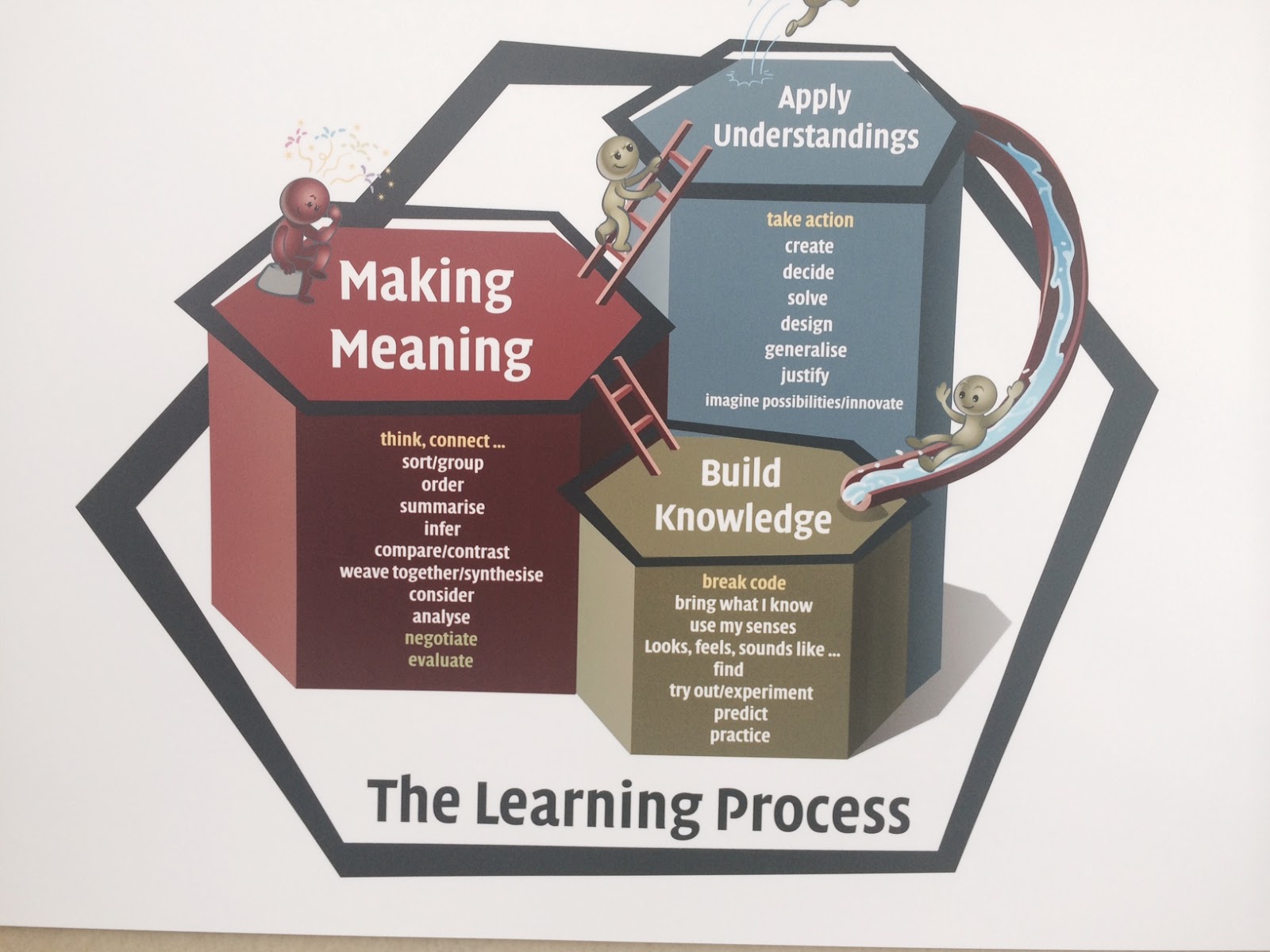
One of the major reflection points that stood out to me was their learning process and how could I integrate this to my reading practice. In my practice I identified that during my reading group discussions I spend a lot of time building knowledge but not really any other the other blocks. Then the majority of my follow-up activities would fall within the making meaning block. But I don't really ever get the apply understanding block within my reading programme. When discuss this as a team it was interesting identifying that our often our students actually struggle answering questions during their reading that require them to apply knowledge to rather than simply retell knowledge. From this reflection I want to explore specifically within my direct teacher instruction time but also within my tasks how I start integrating this learning around applying knowledge.


For my inquiry focus group I have designed a lesson around these three blocks. In this lesson we will look at how characters have different viewpoints on the same situation. Then we will analyse how people all value things differently. From this we will then apply this understanding into a wider world context of valuing water. We will learn and understand how people in our world (including ourselves) value water differently.
I have explicitly stated each of the three blocks to help give the lesson focus:
  • Build knowledge: Understand how and why characters have different viewpoints.
  • Make Meaning: People value things differently (analyse)
  • Apply understanding: How is water valued differently in the world (justify).
I hope that from this lesson students will be able take the knowledge that they learn and then apply it to a wider world context. I am also wanting to design an activity where they have to present their understanding of how people value water differently.


See here for Lesson Planning: Drones Term 2 and for student task: Did you shake your tail feathers?


Some other reflection notes from this visit:


  • If we make our students struggle then will they gain a better growth mindset.
  • In teacher groups are we giving students enough of a scope to grow therefore I need to ensure that I don't limit them yet at the same time make it achievable.
  • Use padlets to get students to share their thinking of a text.
  • I need to get my students to have an attitude of being able to be in the pit (stuck) and know what to do.

Wednesday, May 4, 2016

Friday, March 4, 2016

My 2016 teacher inquiry has begun!

This year Pt England's school-wide teacher inquiry focus is: Formative practice in reading/writing to improve students achievement. From this my personal inquiry for the upcoming year is.

"How can the study of words, their sounds and their parts improve achievement for low readers?"
This focus has come as a result of my inquiry last year into how to lift student vocabulary in reading? During the year I had a specific focus on vocabulary strategies but when I reflected on my end of year reading data I concluded that this focus was of benefit for my higher students but not at all for my lower students. Now this year with the average reading age of my students is even lower, range of 6.9 - 8.5yrs, I want to specifically focus on increasing achievement in reading for Yr 4 & 5 students who are well below standard. In order to do this I want to begin by increasing the actual study of words, their sounds and parts. Even though these students are 4-5 years into school they don't have the content or strategy knowledge to decode texts at their level. In order to complete this inquiry effectively I have chosen a focus group, the Drones, which consists of 7-7.5yr readers.

After analysing last year's data and testing each student within my group this year I establish three summary points. 
- All of my students within the group have low decoding skills. 
- When decoding students often sound out initial sound then simply guess the rest of the word
- At times students just say the first word that comes to mind which has the same first letter. 

From this point forward I have established two areas of focus
 - Tasks: Word study task (Learning to read) & Comprehension (Reading to learn).
 - Reading: The focus and attention within my group reading sessions.  

ptenglendlogo.jpg

Friday, August 7, 2015

Term 3 - Journey to engagement & ownership

This term the two words that come to mind when I consider the next part of my journey are engagement and ownership. At this stage I have the structures in place for my students to be able to identify where they are working at within a SOLO based rubric for mathematic strategies. But I need my students to fully engage with it in order to get results.

Previously I have had my students complete problem solving tasks, then use the Steps to Success rubric to identify what level they are working at and what they need to do next in order to move up a step. The main constraint to this is that the students simply find it just another thing to do and another thing that they can't really be bothered with. When thinking about this issue, I think engagement and ownership are the keys to enabling students to use these steps. If I can get my students to take ownership of their mathematics learning then it would hopefully change this attitude. If students were aware of what level they are at, and then feel personal responsibility to get themselves to a higher level, then lack of engagement would hopefully not be such an issue. Whilst ownership is the ideal goal I think there needs to be other goals/motivations in order to achieve ownership.

This term my focus is to get students more engaged and take more ownership within mathematics. I have a couple ideas of how I could use competition based strategies to get students to engage in their Steps to Success with the hope of their attitude and commitment to learning mathematics improve.


Sunday, July 19, 2015

Term 2 Pitstop


Term 2 Reflection on my personal inquiry. This term my inquiry took a big change from being focused within Writing to now within Maths. I introduced a number of new learning methods which my students quickly took on board. These methods are to give my students the opportunities to develop their strategies for problem solving. These strategies are what they are then able to track their progress with and use to decide what their next learning step is. Here is a presentation that I presented to a group of teachers as an update on my Term 2 journey. 

Monday, March 16, 2015

Going SOLO


How can students being aware of what they are learning and what they need to learn to accelerate cognitive engagement? 

Over the past few weeks I have put much thought into how I could physically carry this out. Initially my plan was to use progressions with each student to identify what level they are working at. Then to make these progressions visible to the students so that they can see what is expected at the next level. But, I have faced a number of problems with this initial plan. Firstly our school progressions are very broad and are not worded in such a way for students to understand and identify achievement clearly. Secondly because the progressions are per year, the progress of a student is going to be very minimal. Therefore, such a goal could potentially be too hard and take too long to give students any sense of achievement and motivation. So this has left me with the need to have small achievable learning steps for each specific learning intention/WALT. 

The new direction which I have now taken to try satisfy this need is to use SOLO Taxonomy. In a recent meeting as a whole staff we explored SOLO and how it provides a model of understanding with several steps. From previous experience I value how SOLO breaks down learning intentions to give the learner explicit steps of their understanding. Therefore students are able to answer these three questions. What am I learning? How is my learning going? What do I need to learn next? 

As a result of this new direction with SOLO my original goals are the same but instead of using progressions directly I will break down each progression with SOLO to create achievable and visible learning steps.