Thursday, September 22, 2016
Term 3 Review: What am I doing differently?
Term 3 has quickly come to a close which means it is time to reflect on my inquiry again. Originally I thought my inquiry had slipped by this term without getting much attention but as I started reflecting I quickly was able to highlight the continual and new developments. This specific inquiry was also a bit overshadowed by my second inquiry of how to develop an effective reading programme that balances breadth and depth. I have made significant changes to my reading programme which has actually aligned itself with this inquiry very well. Through introducing 3-week focus lessons, increasing and widening reading material and connecting texts within a concept it has naturally led to an increase of word study and exposure. As I enter my final term of this inquiry I want to continue developing my practice and hopefully receive some formative results from the end of year testing.

Monday, August 29, 2016
Term 3 - All Go!

Image Attribution: www.pixabay.com
What you would see?
As Term 3 is quickly passing by I reflected on the question; what would someone coming into my classroom see me doing differently? The most visible change would be the focus of my direct teaching group sessions. I am very aware of what words students are struggling to decode and/or comprehend, yet also pre-planned for deliberate words to study and explore. When such words are identified I put them on the whiteboard and get students to ‘explore’ them via a number of different means. Sometimes this might be getting students to find any parts of the word that they recognise or breaking the word into sounds. Other times it I direct students to google the word to find its definition and discuss any connections stemming from this. During these times my students are more engaged than earlier this year in actually wanting to engage with the word and discover its meaning.
What’s the plan?
Already this term I have begun the process of retesting all of my students to give me valuable information on their progress. Specifically for this inquiry I am wanting to see the progress, identify the needs (new or old) and use this to influence my inquiry direction going forward. So far within my inquiry group there has been a mixture some improvement in their decoding, whilst still for others it’s a big need.
Going forward this term I have a few areas of focus:
- Repetition: I want to set up a Padlet, doc or presentation where I can get students to record the words we discuss and use this as a place to revisit to ensure we get good repetition of words.
- Sounds: Look more specifically at sounds within words: Word endings, Contractions, Middle sounds, & Medial Blends.
- New Vocabulary: I want to get my students to become more independent at decoding and defining unknown words. To do this I want to find ways that my students can independently record unknown words, research them and finally share and discuss them with their group.
Thursday, July 7, 2016
The Halfway Point
It has already been two terms since I began my inquiry into improving achievement for my low readers by focusing on sounds and word parts. Over the past two terms I have seen my students gain huge confidence to study words and explore them. This confidence will hopefully lead to my students gaining the skills to understand and decode unknown words. Here is a reflection on my inquiry as I have now reached the halfway point.
Saturday, July 2, 2016
Reality check
Tonight I left my classroom with a greater burden on my heart for my students than I have ever had before. It was teacher/parent interviews, a time to share student mid-year reports. After many discussions with whanau throughout the day, sharing their child's successes, goals and needs, it was nearing the end of the evening. I then had a parent come into my class; a softy, kind spoken man. After showing him his daughters report he displayed a complete sense of helplessness and emotional burden in regards to her position against National Standards. It was hard to see a dad feeling so helpless towards what he could do to help his daughter. It was at this moment that I was reminded and even assured more of the reason why I devote so much of my life to teaching. Now being a dad made it even more real to me the true reality of what my student needs are and how important it is for me to do the absolute best teaching I can. The majority of my students this year a well below the National Standard, so it has been a challenging beginning to the year understand their levels and the progress that they need to make. But from this it has given me more motivation to try new things, keep focused and understand the needs to my learners better. I now look forward to the rest of the year and what this new motivation will bring, with a hope that I can make a significant difference in each of my students lives.
 |
| Image Attribution: http://quotesgram.com/ |
Thursday, June 16, 2016
Making Meaning & Applying Understanding
Stonefields School Visit Reflection:
This term as a whole staff we had the opportunity to visit Stonefields school to observe and learning about their learning frameworks. It was a fascinating visit getting to experience a totally different environment and taking the opportunity to reflect on my own practice.
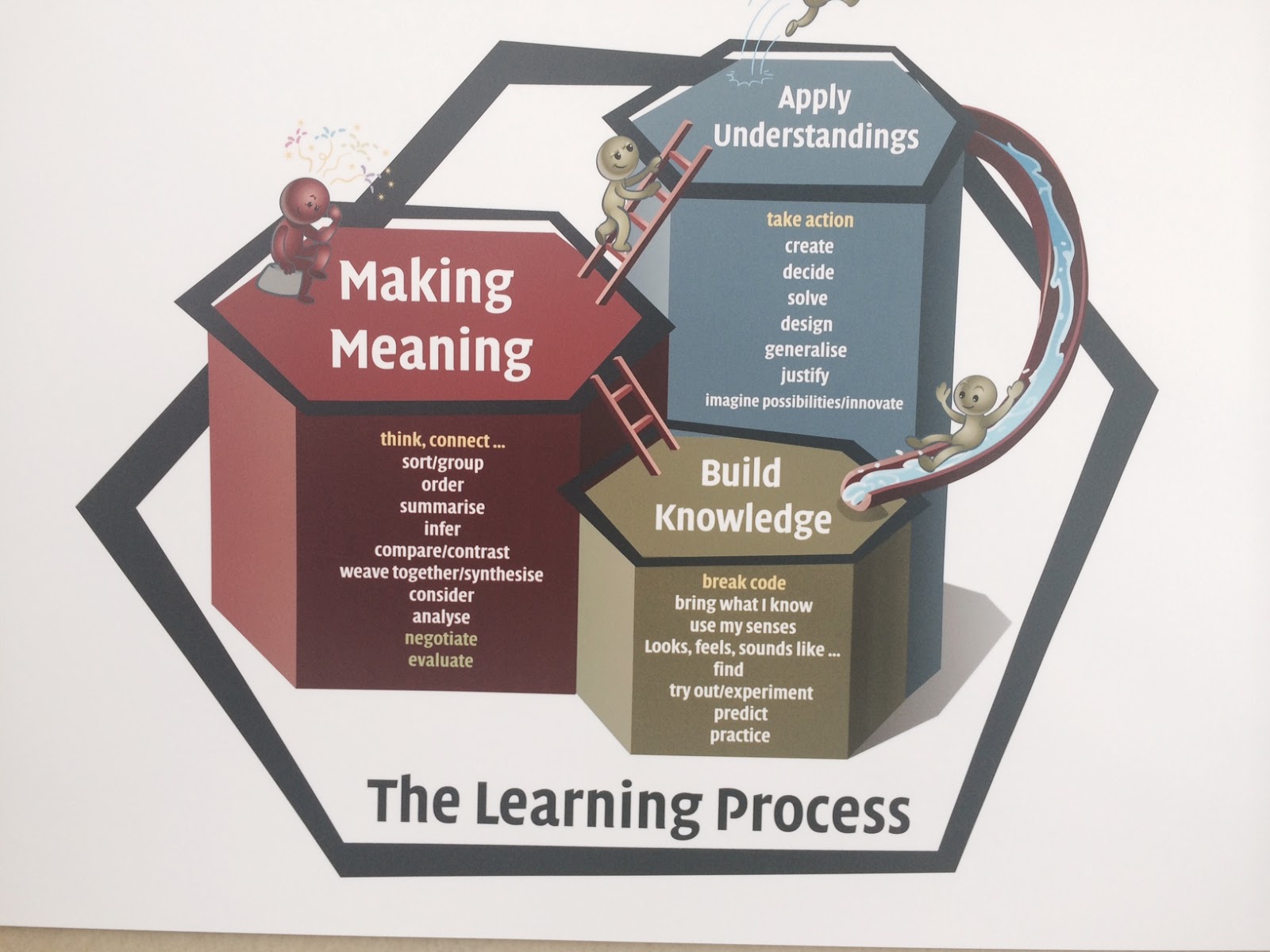 One of the major reflection points that stood out to me was their learning process and how could I integrate this to my reading practice. In my practice I identified that during my reading group discussions I spend a lot of time building knowledge but not really any other the other blocks. Then the majority of my follow-up activities would fall within the making meaning block. But I don't really ever get the apply understanding block within my reading programme. When discuss this as a team it was interesting identifying that our often our students actually struggle answering questions during their reading that require them to apply knowledge to rather than simply retell knowledge. From this reflection I want to explore specifically within my direct teacher instruction time but also within my tasks how I start integrating this learning around applying knowledge.
For my inquiry focus group I have designed a lesson around these three blocks. In this lesson we will look at how characters have different viewpoints on the same situation. Then we will analyse how people all value things differently. From this we will then apply this understanding into a wider world context of valuing water. We will learn and understand how people in our world (including ourselves) value water differently.
I have explicitly stated each of the three blocks to help give the lesson focus:
- Build knowledge: Understand how and why characters have different viewpoints.
- Make Meaning: People value things differently (analyse)
- Apply understanding: How is water valued differently in the world (justify).
I hope that from this lesson students will be able take the knowledge that they learn and then apply it to a wider world context. I am also wanting to design an activity where they have to present their understanding of how people value water differently.
See here for Lesson Planning: Drones Term 2 and for student task: Did you shake your tail feathers?
Some other reflection notes from this visit:
- If we make our students struggle then will they gain a better growth mindset.
- In teacher groups are we giving students enough of a scope to grow therefore I need to ensure that I don't limit them yet at the same time make it achievable.
- Use padlets to get students to share their thinking of a text.
- I need to get my students to have an attitude of being able to be in the pit (stuck) and know what to do.
Wednesday, June 8, 2016
Ideas ideas ideas
As a staff we got the opportunity to meet together to hear about each other's inquiries then share with them some ideas. This was really valuable for me as I was able to hear from teachers who teach in the junior school and have students at a similar level.
A few ideas from this session are:
1. Word Families
- In order to help students with their understanding of words they could form word families. Specifically get them to make word that rhyme.
- Get a physical magnetic alphabet board and allow students time to play and explore words.
2. Memory Games
- To help students with remembering words set students up with memory games where they will have to use words repeatedly. Students need lots of revision before they will actually remember words when they see them in a new context, so this could be a good way of getting repetition.
3. Explain Everything
- To help students with sound knowledge use some of the ready made Explain Everythings to give students practice with their sounds. Wednesday, May 4, 2016
Inquiry - Term 1 Review
Where is 2016 going? One term down already so it must be time for a termly review.
Friday, March 4, 2016
My 2016 teacher inquiry has begun!
This year Pt England's school-wide teacher inquiry focus is: Formative practice in reading/writing to improve students achievement. From this my personal inquiry for the upcoming year is.

"How can the study of words, their sounds and their parts improve achievement for low readers?"
This focus has come as a result of my inquiry last year into how to lift student vocabulary in reading? During the year I had a specific focus on vocabulary strategies but when I reflected on my end of year reading data I concluded that this focus was of benefit for my higher students but not at all for my lower students. Now this year with the average reading age of my students is even lower, range of 6.9 - 8.5yrs, I want to specifically focus on increasing achievement in reading for Yr 4 & 5 students who are well below standard. In order to do this I want to begin by increasing the actual study of words, their sounds and parts. Even though these students are 4-5 years into school they don't have the content or strategy knowledge to decode texts at their level. In order to complete this inquiry effectively I have chosen a focus group, the Drones, which consists of 7-7.5yr readers.
After analysing last year's data and testing each student within my group this year I establish three summary points.
- All of my students within the group have low decoding skills.
- When decoding students often sound out initial sound then simply guess the rest of the word
- At times students just say the first word that comes to mind which has the same first letter.
From this point forward I have established two areas of focus
- Tasks: Word study task (Learning to read) & Comprehension (Reading to learn).
- Reading: The focus and attention within my group reading sessions.
Friday, December 11, 2015
2015 - Looking Backwards & Forward
Where has this year gone? Looking back at the year gone it seems such a blur. When I began the year I was unsure of what I wanted to inquire into as part of my professional teacher development. So I began the year by focusing on establishing a digital tool, Steps to Success, that students could use to self assess their writing and therefore make improvements. I then moved the focus of this digital tool into Mathematics to guide students to use numerous strategies when problem solving. Within both of these areas it was difficult to get students to engage with the tool due to their lack of engagement and ultimately their low key competencies levels. While I was inquiring into these areas the whole staff actually had a professional development focus around vocabulary and reading. Therefore my professional teacher inquiry began to focus on my reading instruction and specifically the teaching of vocabulary. So as I look back at the year I recognise now that I actually put more attention into inquiring into reading without realising and documenting. Now that I am at the end of the year I have reflected on the year past by documenting my reading inquiry and what my goals will be for next year as I will continue to develop and inquire into my reading teaching practice. I hope as you read this or have followed my blog over the year that my inquiry may have proven valuable for your own teaching development and practice.
Wednesday, November 11, 2015
Manaiakalani Film Festival - Ant Boy
It was very exciting to be apart of the 8th annual Manaiakalani Film Festival for the first time this year. As a class we made a film about a boy who transforms into an ant. We wanted to make a film that had relevance to what we had been learning about over the past term. Alongside Trade & Enterprise we had been learning about our emotions and having empathy towards others. So the idea of Ant Boy was born from the phrase "put yourself in someone else's shoes." Hope you enjoy it. Click on the photo below...

Friday, October 30, 2015
Wednesday, October 14, 2015
Term 3 Pitstop
This is an update and reflection on my inquiry journey over the past term. The two key points this term have been around motivation and engagement.
Friday, August 7, 2015
Term 3 - Journey to engagement & ownership
This term the two words that come to mind when I consider the next part of my journey are engagement and ownership. At this stage I have the structures in place for my students to be able to identify where they are working at within a SOLO based rubric for mathematic strategies. But I need my students to fully engage with it in order to get results.
 Previously I have had my students complete problem solving tasks, then use the Steps to Success rubric to identify what level they are working at and what they need to do next in order to move up a step. The main constraint to this is that the students simply find it just another thing to do and another thing that they can't really be bothered with. When thinking about this issue, I think engagement and ownership are the keys to enabling students to use these steps. If I can get my students to take ownership of their mathematics learning then it would hopefully change this attitude. If students were aware of what level they are at, and then feel personal responsibility to get themselves to a higher level, then lack of engagement would hopefully not be such an issue. Whilst ownership is the ideal goal I think there needs to be other goals/motivations in order to achieve ownership.
This term my focus is to get students more engaged and take more ownership within mathematics. I have a couple ideas of how I could use competition based strategies to get students to engage in their Steps to Success with the hope of their attitude and commitment to learning mathematics improve.
 Previously I have had my students complete problem solving tasks, then use the Steps to Success rubric to identify what level they are working at and what they need to do next in order to move up a step. The main constraint to this is that the students simply find it just another thing to do and another thing that they can't really be bothered with. When thinking about this issue, I think engagement and ownership are the keys to enabling students to use these steps. If I can get my students to take ownership of their mathematics learning then it would hopefully change this attitude. If students were aware of what level they are at, and then feel personal responsibility to get themselves to a higher level, then lack of engagement would hopefully not be such an issue. Whilst ownership is the ideal goal I think there needs to be other goals/motivations in order to achieve ownership.
This term my focus is to get students more engaged and take more ownership within mathematics. I have a couple ideas of how I could use competition based strategies to get students to engage in their Steps to Success with the hope of their attitude and commitment to learning mathematics improve.
Sunday, July 19, 2015
Term 2 Pitstop
Term 2 Reflection on my personal inquiry. This term my inquiry took a big change from being focused within Writing to now within Maths. I introduced a number of new learning methods which my students quickly took on board. These methods are to give my students the opportunities to develop their strategies for problem solving. These strategies are what they are then able to track their progress with and use to decide what their next learning step is. Here is a presentation that I presented to a group of teachers as an update on my Term 2 journey.
Friday, May 29, 2015
TV show Raising Children features my class!
Check out this Raising Children episode because it features Pt England School and my class! Only two days left to watch!
Watch Raising Children - Sunday 3 May - TVNZ OnDemand
Watch Raising Children - Sunday 3 May - TVNZ OnDemand
Friday, May 22, 2015
The next leg of the Steps to Success journey
Here is an update of what I have been doing in my inquiry and where I am heading next...
Friday, May 15, 2015
Developing a dialogic, orally expressive classroom.
This term as part of our personal inquiries we have the privilege of having a number of professional development sessions. This week we had Dr Jannie van Hees present on how to develop a dialogic, orally expressive classroom.
In Jannie's presentation there were a number of points where I was challenged to reflect on my practice. She began by asking us two questions. How do you encourage and promote oral language and dialogic teaching? And how do you explicitly grow your student's expression? When reflecting on these questions I found it hard to pinpoint when during the day do I actually explicitly teach and promote oral language. During the day I am continually in conversation with my students but there are not many times when I am deliberately teaching and enabling oral language. Every week when I take literacy reading groups I have 10-20min with a small group of students. During this time we read our text and discuss it with preprepared questions. I am often encouraging students to share and explain their thinking because I am interested in their ideas rather than focused on developing their expression. These times would be perfect opportunities to teach, model and encourage further dialogic expression.
Another major point that I took away from this presentation was the need to gift students with language and vocabulary. Unfortunately many of my students have not had vocabulary and language rich childhoods. Of which this means many of them have limited vocabulary and more importantly limited ability to process and express language. Students need to have this ability to express language because language makes meaning. Meaning is foundational to developing, interacting and communicating fluently in this world. Jannie challenged us with the point that if we continually question students and aren't gifting them new language then they can and will only ever recycle that which they already know. We need to deliberately input language into our students otherwise there will be no increase. Once we gift students language then their brains can be pushed and their expression can grow.
As practical application from this discussion there are a couple activities that I want to incorporate within my daily classroom practise.
Provide extended texts, talk and videos to students to gift them vocabulary. Then to establish this vocabulary and challenge their brains get them hold, discuss and retell the information.
- Before completing a piece of writing get students to sort the information in their head, retain their whole story and share to their peers or back as a whole class.
- Have a word of the day where as a class we explore a new word and challenge ourselves to use it throughout the day/week.

Saturday, May 9, 2015
Prize wheel - Positive behaviour!
This term we have been wanting to introduce a new positive behaviour system into our big learning space. So after some thought and a days work this is my next big idea. Throughout the day students will be rewarded for positive behaviours and focused learning. Each rewarded student will have their name written onto the Wheel of Fortune. Once the wheel is full of names the wheel will be spun and the lucky student(s) will be rewarded. After this all the names will simply be rubbed off and another round will begin.

Thursday, April 2, 2015
Friday, March 27, 2015
Steps to Success
Over the past couple of weeks I have been trying to develop an chart that will enable students to identify where they are and what they need to do to achieve a higher standard. To begin my inquiry I have focused on writing and specifically punctuation. Before getting to my final chart I went through a number of steps to ensure that they would be accurate and also work well digitally on student blogs.
Chart 1: I inserted progressions into spreadsheets but these were too broad to be effective.


Chart 1: I inserted progressions into spreadsheets but these were too broad to be effective.

Chart 2: I took on specific writing progression and using SOLO made a chart which students could identify themselves on and see their next step. The downfall with this chart was when embedding a Google Spreadsheet into a blog the size adjustments are not very smooth and it is too difficult for students to do it themselves.

Chart 3: Using the same information as the previous chart I make this chart in Google Presentations. This worked much better because the process of embedding a presentation into a blog is easier and students can easily adjust the size to fit the layout of their blog nicely. The bonus of this chart being embedded into the blog means that student can add links to pieces of writing as evidence and they don't need to update their blog because it updates automatically. Also another bonus is that these links work when embedded on their blog so any viewer of their blog to click on and see their writing evidence.

Chart 4: After presenting this chart and working through it with a number of students I quickly discovered that I needed to make each step very clear and give more detail. For example I needed to state how many sentences a couple is. So my final process has been to amend each steps and this is the final chart of which I am using with my students at this stage.

Subscribe to:
Posts (Atom)