Thursday, June 16, 2016

Making Meaning & Applying Understanding

Stonefields School Visit Reflection:
This term as a whole staff we had the opportunity to visit Stonefields school to observe and learning about their learning frameworks. It was a fascinating visit getting to experience a totally different environment and taking the opportunity to reflect on my own practice.
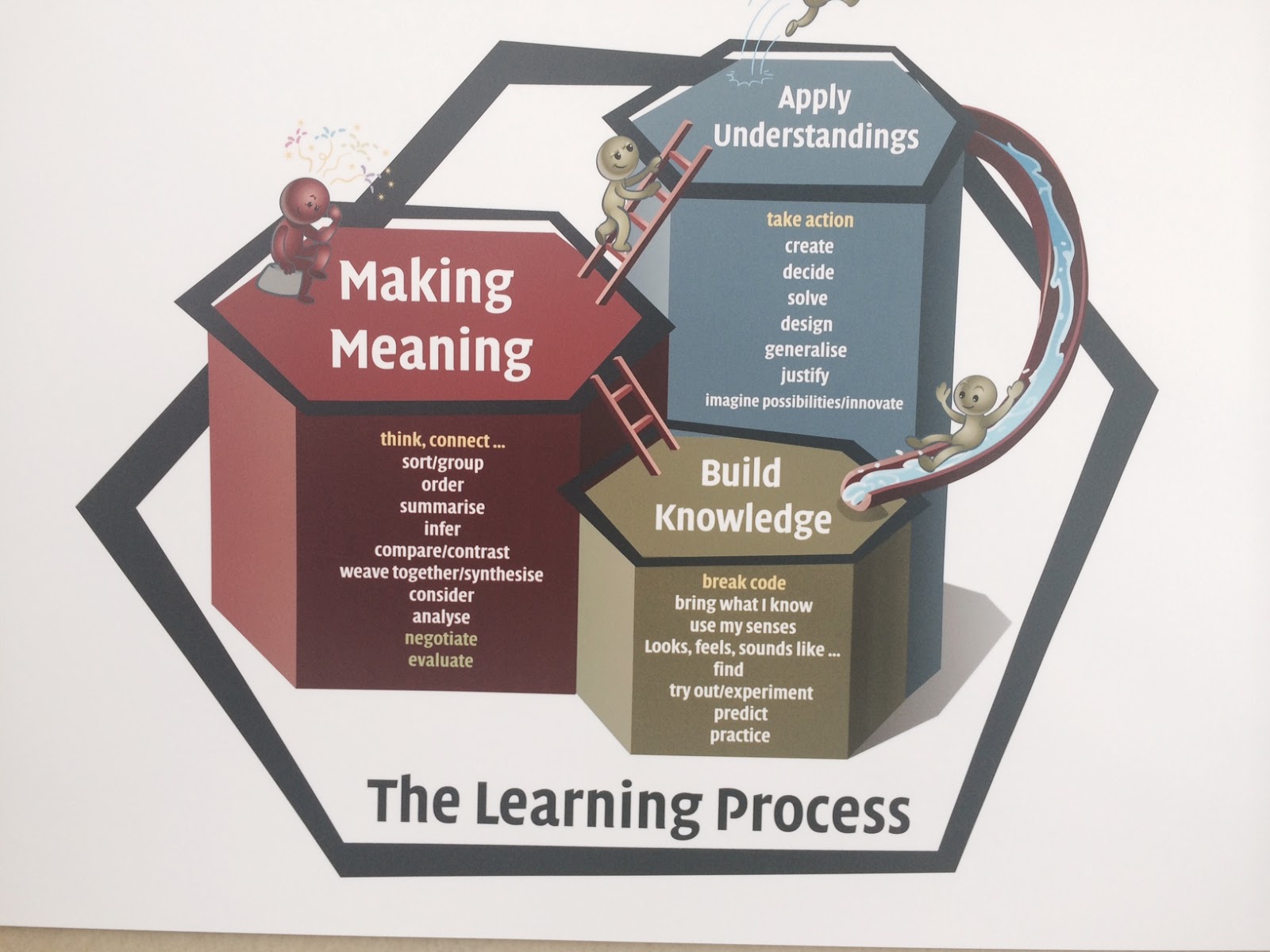

One of the major reflection points that stood out to me was their learning process and how could I integrate this to my reading practice. In my practice I identified that during my reading group discussions I spend a lot of time building knowledge but not really any other the other blocks. Then the majority of my follow-up activities would fall within the making meaning block. But I don't really ever get the apply understanding block within my reading programme. When discuss this as a team it was interesting identifying that our often our students actually struggle answering questions during their reading that require them to apply knowledge to rather than simply retell knowledge. From this reflection I want to explore specifically within my direct teacher instruction time but also within my tasks how I start integrating this learning around applying knowledge.


For my inquiry focus group I have designed a lesson around these three blocks. In this lesson we will look at how characters have different viewpoints on the same situation. Then we will analyse how people all value things differently. From this we will then apply this understanding into a wider world context of valuing water. We will learn and understand how people in our world (including ourselves) value water differently.
I have explicitly stated each of the three blocks to help give the lesson focus:
  • Build knowledge: Understand how and why characters have different viewpoints.
  • Make Meaning: People value things differently (analyse)
  • Apply understanding: How is water valued differently in the world (justify).
I hope that from this lesson students will be able take the knowledge that they learn and then apply it to a wider world context. I am also wanting to design an activity where they have to present their understanding of how people value water differently.


See here for Lesson Planning: Drones Term 2 and for student task: Did you shake your tail feathers?


Some other reflection notes from this visit:


  • If we make our students struggle then will they gain a better growth mindset.
  • In teacher groups are we giving students enough of a scope to grow therefore I need to ensure that I don't limit them yet at the same time make it achievable.
  • Use padlets to get students to share their thinking of a text.
  • I need to get my students to have an attitude of being able to be in the pit (stuck) and know what to do.


Wednesday, June 8, 2016

Ideas ideas ideas

As a staff we got the opportunity to meet together to hear about each other's inquiries then share with them some ideas. This was really valuable for me as I was able to hear from teachers who teach in the junior school and have students at a similar level.


A few ideas from this session are:
1. Word Families
- In order to help students with their understanding of words they could form word families. Specifically get them to make word that rhyme.
- Get a physical magnetic alphabet board and allow students time to play and explore words.


2. Memory Games
- To help students with remembering words set students up with memory games where they will have to use words repeatedly. Students need lots of revision before they will actually remember words when they see them in a new context, so this could be a good way of getting repetition.


3. Explain Everything
- To help students with sound knowledge use some of the ready made Explain Everythings to give students practice with their sounds.  

Wednesday, May 4, 2016

Friday, March 4, 2016

My 2016 teacher inquiry has begun!

This year Pt England's school-wide teacher inquiry focus is: Formative practice in reading/writing to improve students achievement. From this my personal inquiry for the upcoming year is.

"How can the study of words, their sounds and their parts improve achievement for low readers?"
This focus has come as a result of my inquiry last year into how to lift student vocabulary in reading? During the year I had a specific focus on vocabulary strategies but when I reflected on my end of year reading data I concluded that this focus was of benefit for my higher students but not at all for my lower students. Now this year with the average reading age of my students is even lower, range of 6.9 - 8.5yrs, I want to specifically focus on increasing achievement in reading for Yr 4 & 5 students who are well below standard. In order to do this I want to begin by increasing the actual study of words, their sounds and parts. Even though these students are 4-5 years into school they don't have the content or strategy knowledge to decode texts at their level. In order to complete this inquiry effectively I have chosen a focus group, the Drones, which consists of 7-7.5yr readers.

After analysing last year's data and testing each student within my group this year I establish three summary points. 
- All of my students within the group have low decoding skills. 
- When decoding students often sound out initial sound then simply guess the rest of the word
- At times students just say the first word that comes to mind which has the same first letter. 

From this point forward I have established two areas of focus
 - Tasks: Word study task (Learning to read) & Comprehension (Reading to learn).
 - Reading: The focus and attention within my group reading sessions.  

ptenglendlogo.jpg

Friday, December 11, 2015

2015 - Looking Backwards & Forward


Where has this year gone? Looking back at the year gone it seems such a blur. When I began the year I was unsure of what I wanted to inquire into as part of my professional teacher development. So I began the year by focusing on establishing a digital tool, Steps to Success, that students could use to self assess their writing and therefore make improvements. I then moved the focus of this digital tool into Mathematics to guide students to use numerous strategies when problem solving. Within both of these areas it was difficult to get students to engage with the tool due to their lack of engagement and ultimately their low key competencies levels. While I was inquiring into these areas the whole staff actually had a professional development focus around vocabulary and reading. Therefore my professional teacher inquiry began to focus on my reading instruction and specifically the teaching of vocabulary. So as I look back at the year I recognise now that I actually put more attention into inquiring into reading without realising and documenting. Now that I am at the end of the year I have reflected on the year past by documenting my reading inquiry and what my goals will be for next year as I will continue to develop and inquire into my reading teaching practice. I hope as you read this or have followed my blog over the year that my inquiry may have proven valuable for your own teaching development and practice.

Wednesday, November 11, 2015

Manaiakalani Film Festival - Ant Boy

It was very exciting to be apart of the 8th annual Manaiakalani Film Festival for the first time this year. As a class we made a film about a boy who transforms into an ant. We wanted to make a film that had relevance to what we had been learning about over the past term. Alongside Trade & Enterprise we had been learning about our emotions and having empathy towards others. So the idea of Ant Boy was born from the phrase "put yourself in someone else's shoes." Hope you enjoy it. Click on the photo below...